

Most businesses try to solve their biggest problems at the top.
Growth.
Marketing.
New offerings.
New markets.
Energy flows toward the visible parts of the business. The places where momentum feels exciting and progress feels measurable.
Underneath those goals sits something quieter and more powerful: the structure that allows the business to function every day.
A business operates on layers of needs, much like the hierarchy of human needs described by Abraham Maslow. Each layer supports the next. Stability at the bottom allows everything above it to grow.
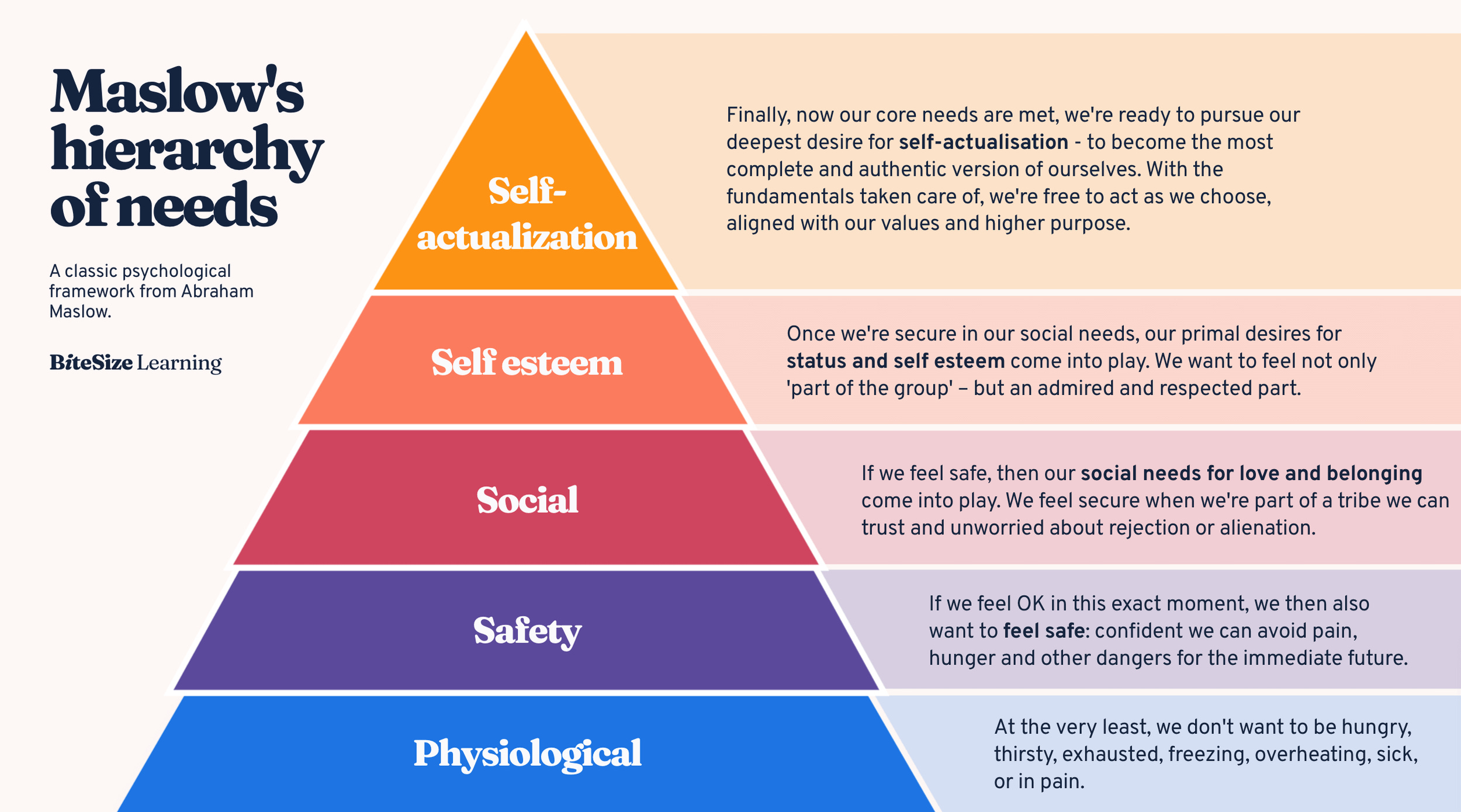
When the foundation is strong, progress feels natural. When the foundation struggles, growth becomes exhausting.
This model helps explain why.
Level 1: Basic Function
The business works day-to-day.
Every organization starts here. This layer covers the basic tools that allow work to happen.
Reliable devices.
Internet connectivity.
Consistent software.
Standard setups for accounts and equipment.
At this level, the goal is simple: work can begin without friction.
Many early businesses operate in an environment where tools appear organically over time. Devices get purchased when something breaks. Accounts get created when someone needs access. Systems evolve without a plan.
The result is a patchwork environment where every small issue interrupts momentum.
Stability at this level creates breathing room. Work begins smoothly and continues without unnecessary interruptions.
Level 2: Security
The business is protected.
Once the tools exist, the next need is safety.
Businesses store information, communicate with clients, and rely on digital systems every day. Security protects those systems and ensures the organization can recover if something goes wrong.
This includes:
Backups
Account protection
Cybersecurity
Access control
Security transforms risk into resilience. Problems become manageable events rather than business-ending disasters.
A business that knows its systems are safe gains something valuable: confidence in its operations.
Level 3: Collaboration
People can work together clearly.
Organizations grow through collaboration. Teams need shared systems that allow information to move easily between people.
At this level, structure begins to appear inside the business.
Communication platforms
Shared documents
Organized knowledge
Clear workflows
When collaboration systems are strong, teams move faster with less confusion. Information becomes accessible, decisions become easier, and new employees can join without slowing everything down.
This layer often marks the transition from a collection of individuals working independently to a true organization.
Level 4: Optimization
The business runs efficiently.
With the foundational layers in place, the organization begins refining how work happens.
Automation enters the picture.
Processes become streamlined.
Manual work becomes lighter.
At this level, systems begin returning time to the people who run the business.
Efficiency frees up attention and energy. The organization starts focusing less on maintaining operations and more on improving them.
Level 5: Growth and Innovation
The business creates new value.
The highest layer is where creativity, strategy, and innovation thrive.
New services.
New ideas.
New ways of delivering value.
This level represents the work many founders imagine when they begin their businesses. It is the space where the organization can expand its impact and pursue its vision.
Reaching this layer requires stability underneath it. Each level below supports the one above.
Where Most Small Businesses Get Stuck
Many small businesses spend years navigating the lower layers of the pyramid.
Technology issues.
Disconnected tools.
Operational friction.
These problems absorb time and attention that founders would rather spend on their craft or their clients.
The business still grows, but the process feels heavier than it should.
A stable foundation changes that experience entirely.
When systems work reliably, teams communicate clearly, and the environment feels secure, the organization gains the freedom to focus on its real mission.
Building a Sustainable Business
A sustainable business grows from strong foundations.
With those layers in place, growth and innovation become a natural extension of the work rather than a constant uphill climb.
Most small businesses try to grow before their foundation is stable.
If your systems feel scattered, slow, or harder to manage than they should be, the issue often sits in the lower levels of the hierarchy.
Take a step back and look at your foundation:
• Do your tools work reliably every day?
• Are your systems secure and backed up?
• Can your team collaborate without friction?
• Are processes streamlined and efficient?
If you’re unsure, we help small businesses audit their technology foundations and identify the fastest path toward a stable, scalable environment.
If you’d like help mapping your organization’s hierarchy of needs, reach out. A short conversation can often reveal where the biggest improvements are hiding.

Let’s build what’s next.
👉 Interested in joining? We cannot wait to meet you! Fill out this form to be contacted by one of our concierges. Ready to jump right in? Visit https://buy.stripe.com/5kA8zh9UGaRA1ri9AL to join.
👉 Follow us On Instagram and help us reach 1,000 followers!